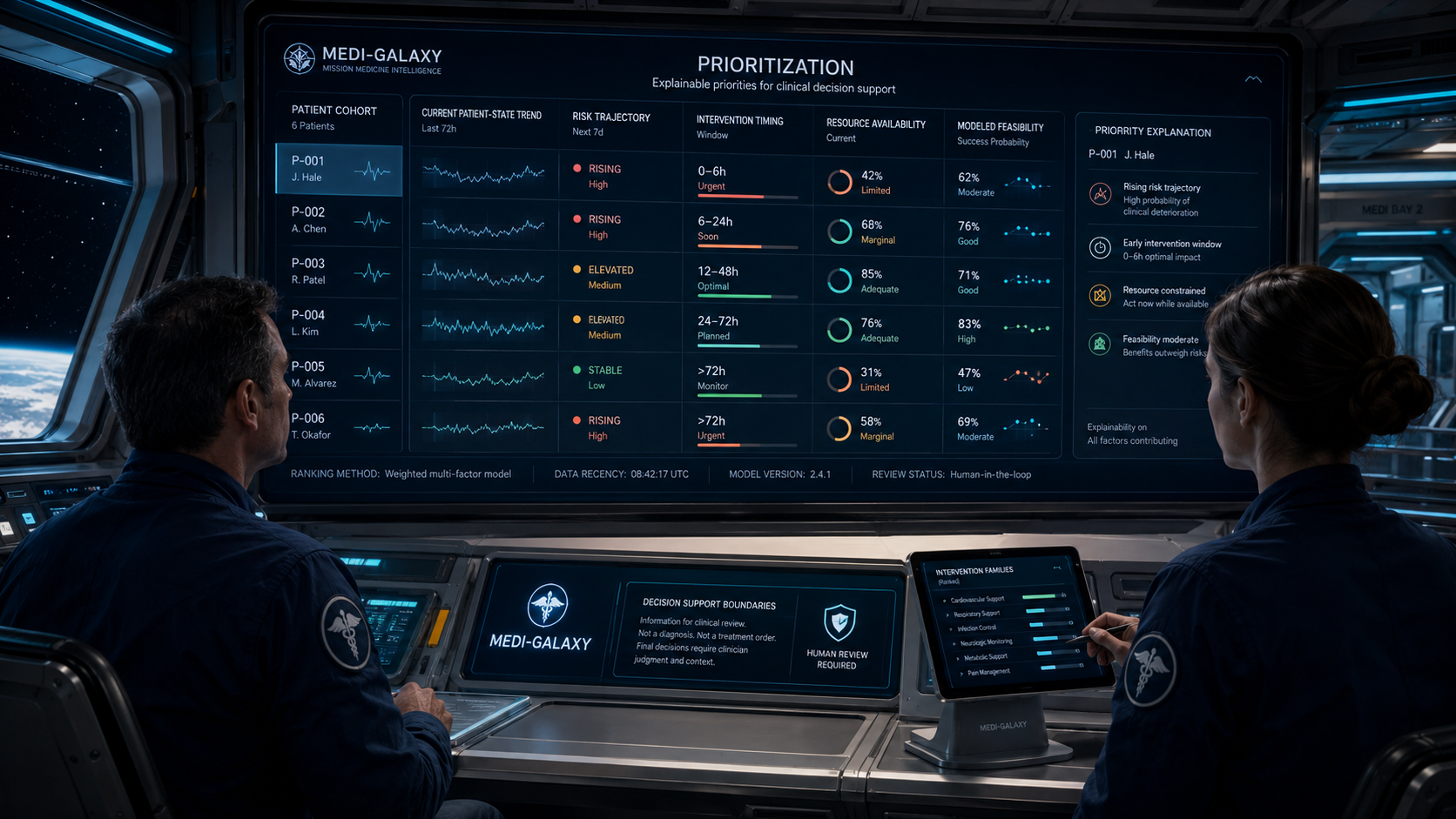
What this means
- Connects scenario conditions to visible prioritization logic instead of opaque recommendations.
- Supports reviewer confidence by showing why one intervention family may deserve attention before another.
- Keeps the system framed as decision support for simulation, training, and review rather than autonomous clinical authority.
Signals to review
- Current patient-state trend
- Risk trajectory
- Intervention timing
- Resource availability
- Modeled feasibility
Trust value
- Readable rationale lets partners inspect the pathway from inputs to suggested priorities.
- Scenario replay can show whether the same conditions produce consistent prioritization behavior.
- Clear boundaries reduce ambiguity around what the system is and is not claiming to do.
Scope note: This topic supports simulation, research, education, training, mission-preparedness review, and partner discussion. It is not presented as clinical diagnosis, autonomous treatment, or replacement for licensed medical professionals or approved flight medical protocols.