Action status clarity
Separates resolved, unresolved, blocked, not-indicated, not-applicable, and follow-up history instead of flattening everything into success or failure.
Space Medical Simulation & Emergency Response Intelligence
Medi-Galaxy models patient state, spacecraft environmental constraints, limited resources, procedure sequencing, and treatment-priority reasoning so crews, researchers, and partners can study emergency pathways before missions depend on them.

In orbital, lunar, Martian, and commercial missions, medical decisions are shaped by communication delay, limited supplies, microgravity or partial-g, contamination risk, cabin systems, crew workload, and procedure feasibility.
Train and evaluate emergency response pathways before crews face isolated, time-sensitive conditions.
Keep recommendations tied to the actual operating environment, not a generic treatment room assumption.
Prioritize clarity, sequencing, and recovery analysis for humans reviewing high-risk options under pressure.
Present the system in a form suitable for grants, technical review, research pilots, and agency or private-sector evaluation.
Medi-Galaxy is designed to show what happened, why the system prioritized it, what remained blocked or unresolved, and when the scenario should hand off to serial reassessment instead of stale ownership.
Room context, gravity state, cabin pressure, oxygen, contamination exposure, crew limitations, and supply constraints.
02Airway, circulation, shock, hemorrhage, trauma burden, treatment response, and recovery or deterioration trends.
03Scenario-specific lanes for airway failure, hemorrhage, thoracic trauma, burns, acute abdomen, FBAO, and fracture stabilization.
04Procedure ordering, feasibility, resource tradeoffs, route ownership, and action timing under realistic constraints.
05Retries or promotes rescue paths when realistic options remain, while distinguishing missed opportunity from exhausted pathways.
06Explainable output for human review, training, after-action analysis, and mission-preparedness planning.
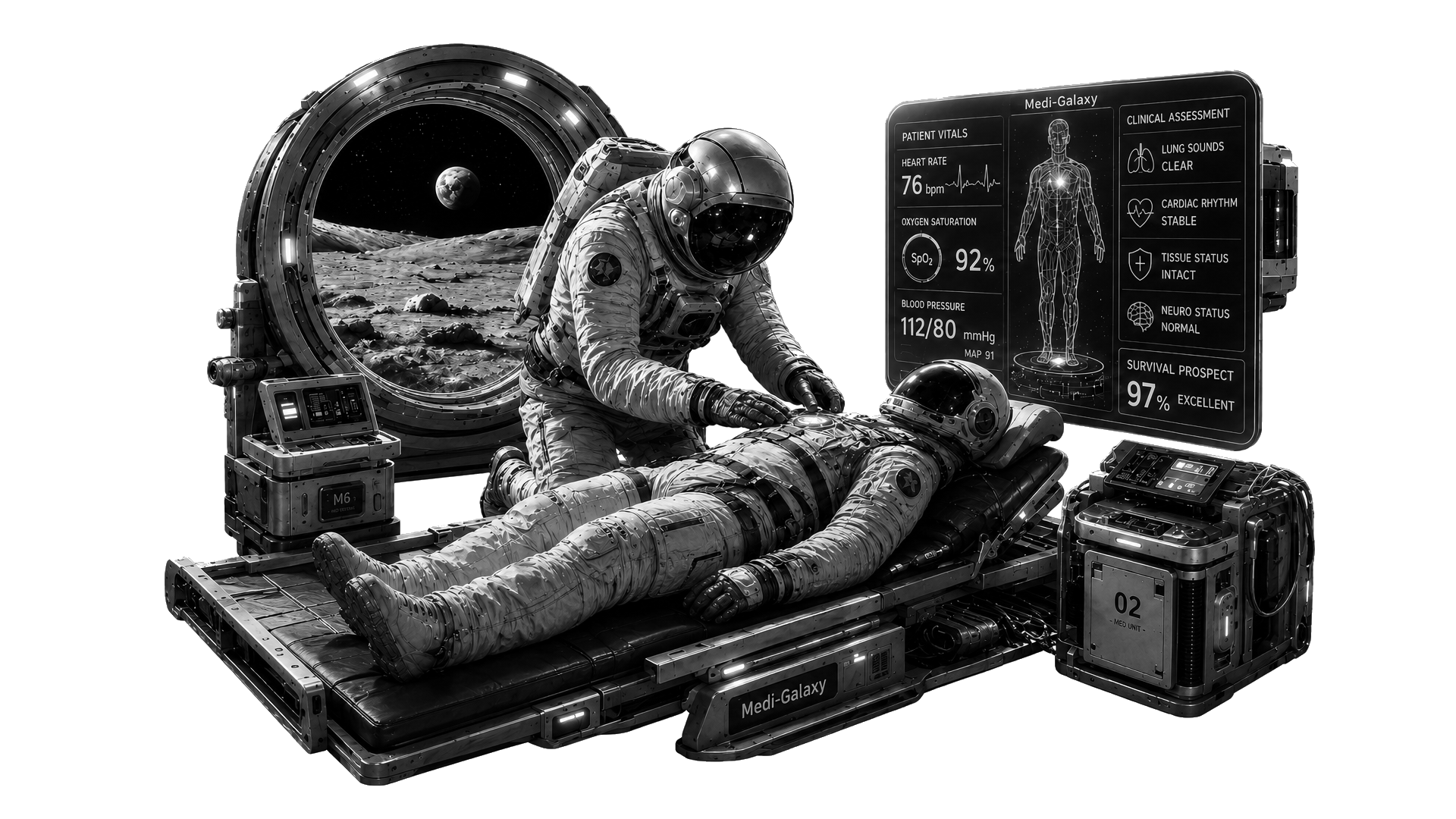
The system is being shaped around traceability: why an action was recommended, why another action was blocked, when a rescue was retried, and whether source control was resolved, unresolved, not applicable, or only historical follow-up.
Separates resolved, unresolved, blocked, not-indicated, not-applicable, and follow-up history instead of flattening everything into success or failure.
Emergency surgery should precede closure, closure should precede sterile reset, and cleanup should not complete before definitive closure.
Generic obstruction does not become a foreign-body airway case unless FBAO-specific evidence supports that family.
When a realistic rescue option remains, the system can requeue or promote the route instead of ending a scenario catastrophically because a scheduler missed a retry.
Recovery and failure analysis should explain the correct subsystem and avoid punishing stale labels after physiology and hemostasis recover.
Medi-Galaxy supports review, training, and simulation; licensed medical authority and validated protocols remain essential.
Each scenario family is useful because it tests a different kind of reasoning: sequencing, source control, airway ownership, environmental limits, or recovery handoff.
Tests airway stabilization, blood delivery, hemostasis, sedation feasibility, and route handoff.
Tracks blood, binder, wound closure, hemostasis truth, stale labels, and physiology recovery.
Models preoxygenation, decompression, eFAST, chest tube/drainage, and ventilation support.
Tests whether emergency surgery can proceed under penalty when waiting for perfect readiness is more dangerous.
Separates airway suction, stabilization, burn cleanup, resuscitation, and reassessment after normalization.
Requires foreign-body-specific evidence before bronchoscopy, thrusts, or FBAO route ownership dominate.
Keeps splinting, regional nerve block, binder, and local stabilization from being mislabeled as unresolved surgery.
Dynamic patient-state tracking across airway, circulation, trauma, shock, and treatment response.
Spacecraft context, altered gravity, atmospheric constraints, contamination exposure, and procedural stability.
Intervention sequencing based on risk, feasibility, resource limits, and rescue opportunities.
Simulation, training, preparedness, and technical review without overstating clinical readiness.
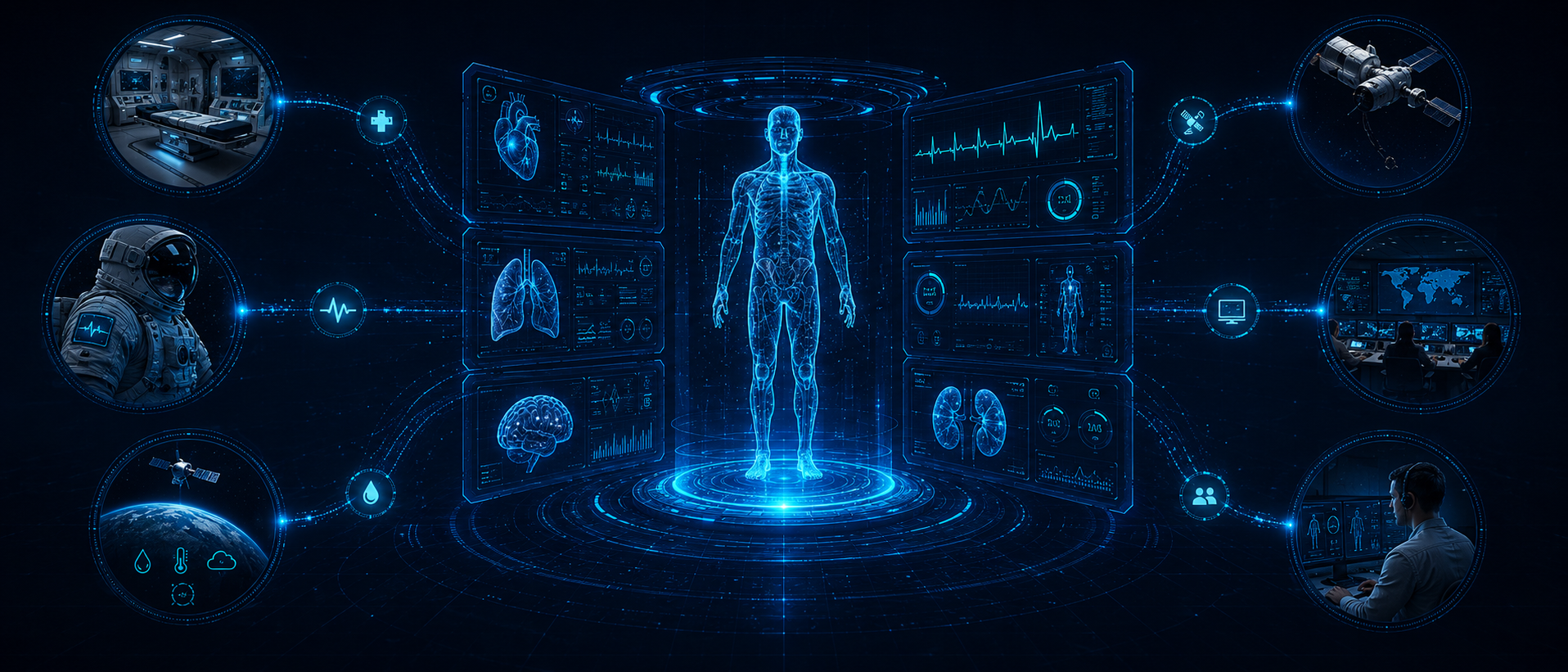
Partial-g treatment planning, constrained movement, delayed evacuation, and limited resources.
Mars TransitEmergency response with communication delays and limited Earth-based medical support.
Commercial CrewScenario-based training and readiness review for private mission profiles.
Deep SpaceMedical planning for constrained inventories, prolonged mission duration, and austere procedures.

Medi-Galaxy supports conversations across aerospace medicine, physiology simulation, emergency medicine, resource-constrained operations, crew training, AI explainability, and exploration-class mission readiness.

The strongest funding story is not that Medi-Galaxy is already a clinical product. It is that Medi-Galaxy is a serious, explainable simulation and preparedness platform with a practical path toward validation, review, and partner-led development.
Human spaceflight expansion increases the need for autonomous preparedness, training, and resource-aware medical planning.
Supports future lunar, Martian, orbital, and commercial mission readiness conversations.
Enables scenario replay, output review, simulation comparison, and explainability analysis.
Simulation expansion, research validation, infrastructure scaling, educational deployment, and pilot demonstrations.
Medi-Galaxy is framed for simulation, training, research, and preparedness review. The platform should support human understanding, not claim autonomous medical authority.

Medi-Galaxy LLC is open to conversations with research partners, aerospace organizations, grant reviewers, education programs, technical advisors, and private or government spaceflight teams.
The one-pager is intended for first-pass review, grant conversations, and technical partner introductions.
Download One-Pager PDF Scan to download PDF