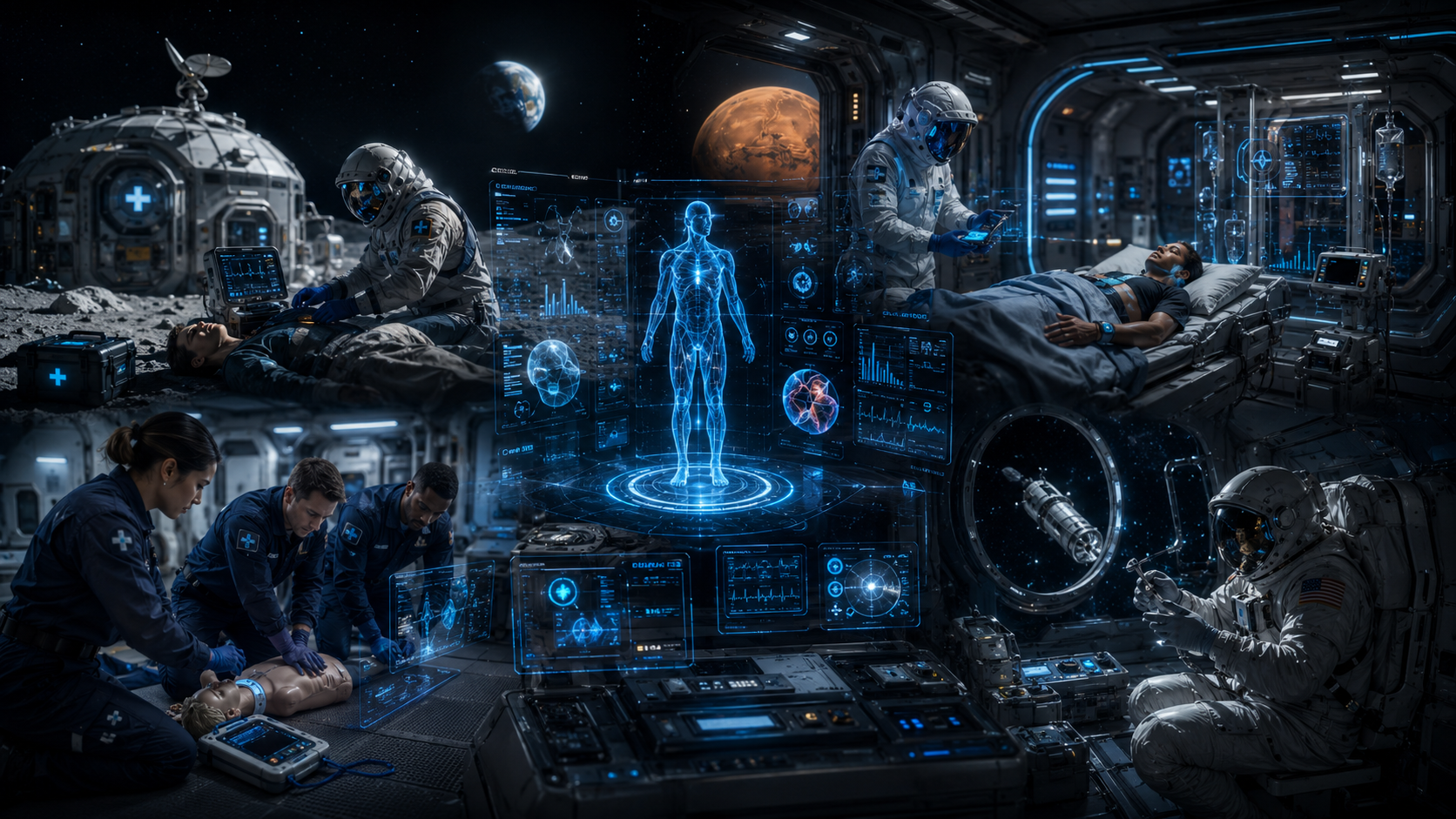
A scenario describes the medical or mission problem being modeled. A drill uses that problem as a structured exercise in which participants can practice recognition, communication, sequencing, resource decisions, adaptation, and reassessment.
Drills connect the scenario engine to applied preparedness without claiming that a simulated exercise alone establishes clinical competency.
Mission-relevant practice
Practice against represented environmental, resource, personnel, timing, or communication constraints rather than an unconstrained treatment-room assumption.
Team & communication practice
Use drills to examine coordination, role clarity, communication, sequencing, and handoff behavior as part of the exercise.
After-action review
Examine what was attempted, completed, delayed, blocked, repeated, or omitted and connect the outcome to the constraints and reasoning that shaped the pathway.
Changed-condition repetition
Repeat a drill with altered resources, mission conditions, timing, personnel availability, or new information to test adaptation instead of memorization.
Training boundary: Drill performance is preparedness evidence within the exercise context; it should not be represented as clinical certification or independent proof of operational medical competency.