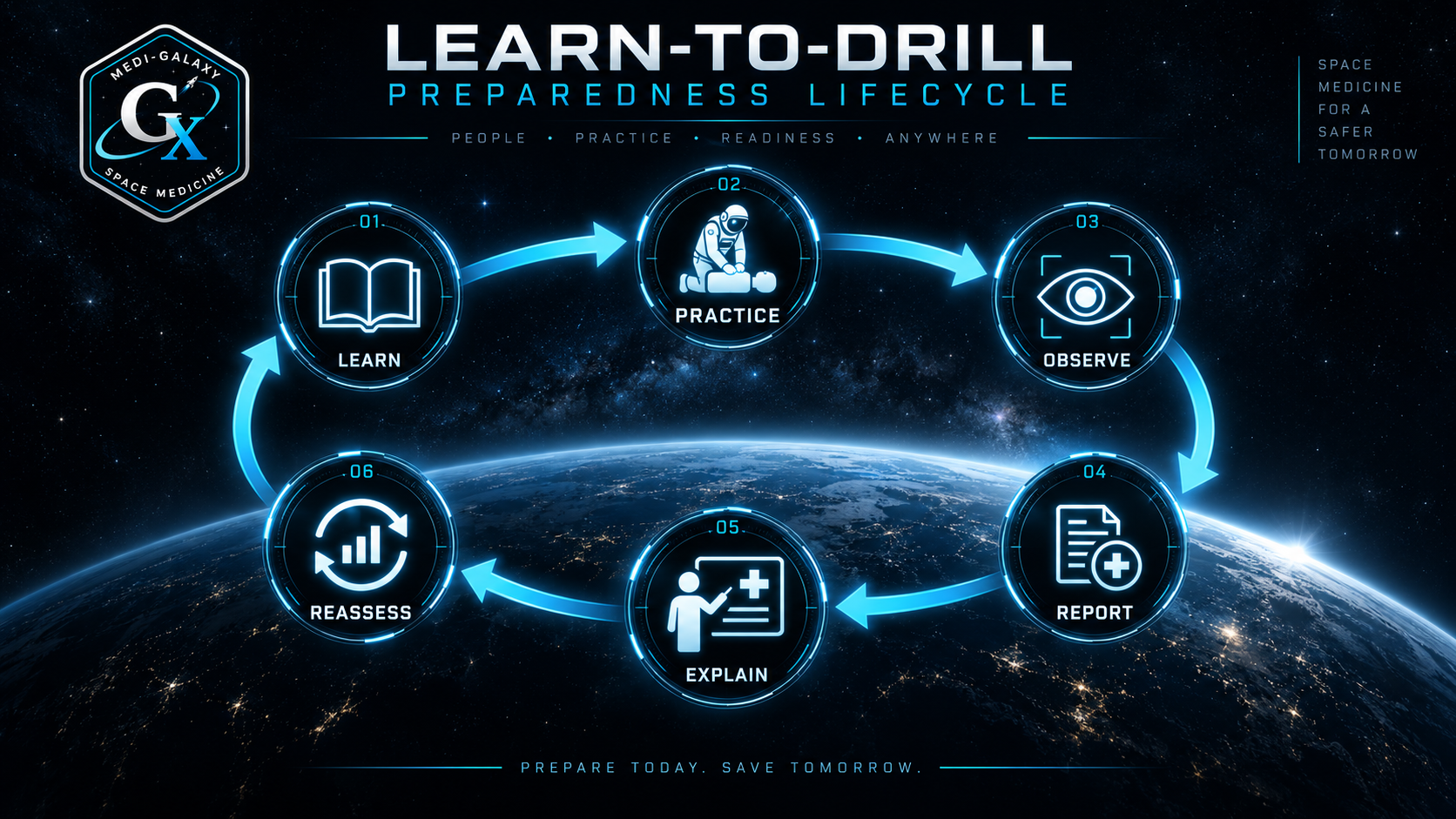
Workflow purpose: Connect structured learning with applied practice, after-action understanding, and continuing preparedness.
01
Learn — Build the knowledge foundation
Begin with relevant material in the Medi-Galaxy Academy. Learning content can introduce concepts, terminology, mission context, decision logic, environmental constraints, and preparedness principles before a learner enters an exercise.
- Understand the problem or hazard being prepared for.
- Recognize what information, mission conditions, resources, and limitations may matter.
- Understand action dependencies, sequencing, and reassessment concepts.
Expected output: a learner prepared to apply relevant concepts in a scenario or drill.
02
Practice — Apply knowledge in a scenario or drill
Move from structured learning into a scenario-based simulation or drill. The participant applies concepts while working through represented patient state, mission context, environmental conditions, resources, timing, communication, and other constraints.
- Recognize the developing problem.
- Select and sequence actions within represented constraints.
- Communicate, adapt, and identify when a pathway is blocked or requires reassessment.
Expected output: a traceable record of how a participant or team responded under the represented conditions.
03
Review — Examine actions, reasoning, constraints, and outcomes
After the exercise, use structured review instead of reducing performance to a simple pass/fail result. Review what happened, why it happened, what changed, what remained unresolved, and what the system explained.
- Actions attempted, completed, delayed, blocked, repeated, or omitted.
- Information, resources, dependencies, and environmental constraints that shaped the pathway.
- Changes in represented patient state or operational options.
- Priorities, blocked pathways, rescue options, and reassessment triggers visible in explainable output.
Expected output: an explainable after-action picture of performance and scenario progression.
04
Improve — Identify preparation gaps
Use after-action review to identify specific areas where further preparation would be useful rather than recommending generic additional training.
- Knowledge that needs reinforcement.
- Sequencing, dependency, or communication gaps.
- Missed resource or environmental considerations.
- Delayed recognition of changing conditions or insufficient reassessment.
Expected output: specific areas for further learning, preparation, or practice.
05
Repeat — Change the conditions and practice again
Repeat the exercise under deliberately altered conditions so participants demonstrate adaptable understanding rather than memorization of one script.
- Vary represented resources, mission environment, timing, communication, personnel availability, scenario progression, or competing priorities.
- Observe whether reasoning adapts appropriately to the changed constraints.
- Use the new run as another reviewable learning cycle.
Expected output: continuing improvement across varied, repeatable preparedness exercises.
Responsible scope: Academy content, scenarios, and drills support education, simulation, and preparedness. They do not substitute for licensed clinical education, accredited qualification requirements, or approved medical protocols.