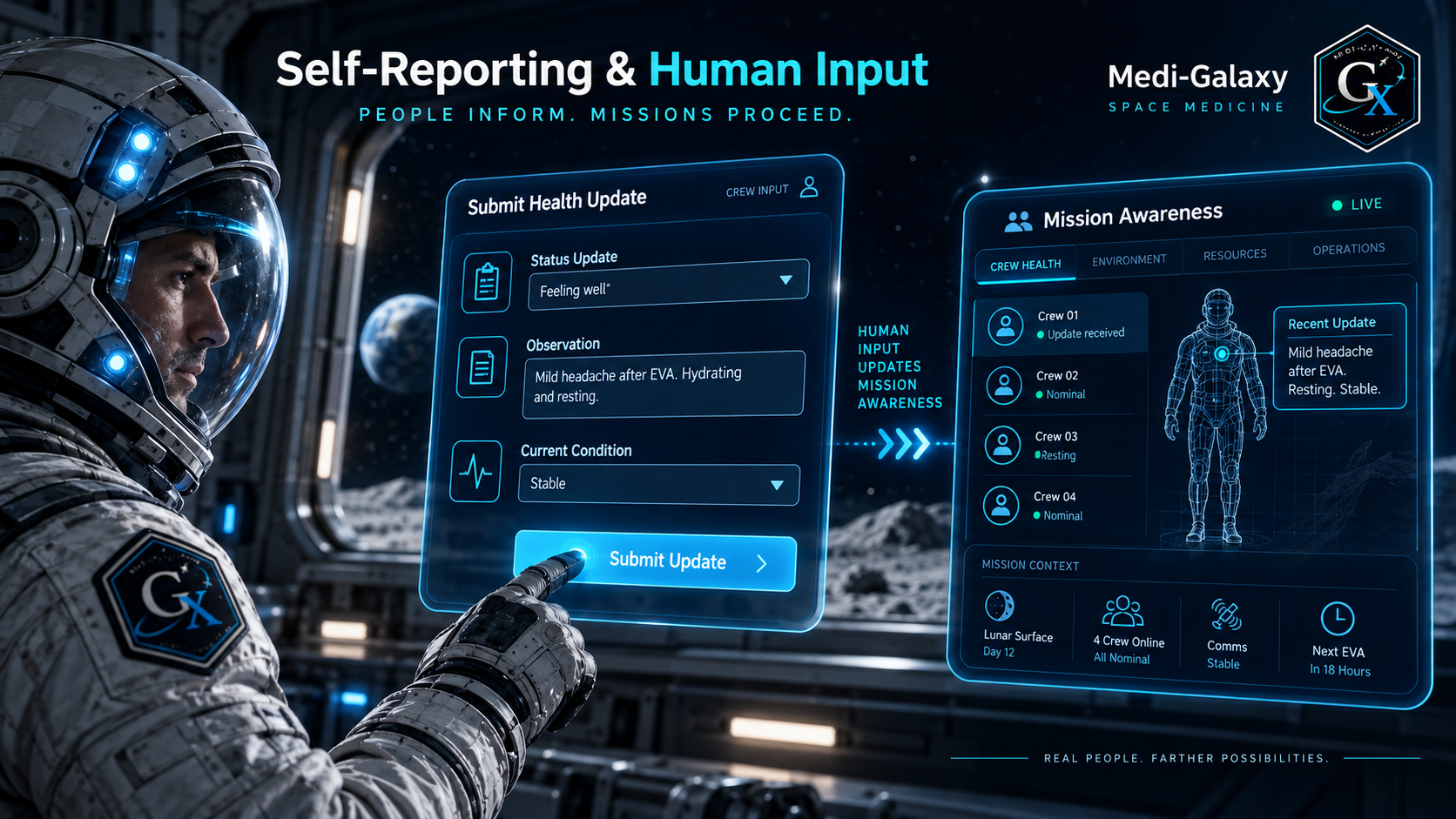
Workflow purpose: Support ongoing awareness and human participation instead of treating one snapshot or one system output as permanently authoritative.
01
Observe — Review current represented conditions
Start with the current information available to the supported workflow so the operational picture reflects represented status rather than relying indefinitely on stale information.
- Review represented person or patient status, trends, mission environment, resources, operational conditions, unresolved concerns, and current phase as available.
- Identify what is current, what may be aging, and where important information is absent or uncertain.
Expected output: a current situational picture based on the information presently available.
02
Report — Add human or self-reported information
Allow a person to contribute structured information that may not already be represented in the current view. Human-provided information should remain clearly attributable to its source.
- Add a status change, observation, concern, confirmation, activity update, or other supported contextual information.
- Preserve the distinction between human-reported information and system-derived or modeled information.
- Treat self-reports as inputs to awareness and reassessment, not autonomous diagnoses.
Expected output: a documented human-provided update with clear source attribution.
03
Integrate — Update the operational picture
Incorporate new information into the current context while preserving provenance and uncertainty instead of flattening all evidence into a single undifferentiated status.
- Determine whether the update materially changes the picture.
- Identify agreement, conflict, uncertainty, new constraints, or resolved concerns.
- Avoid promoting uncertain or self-reported information beyond its evidentiary strength.
Expected output: an updated operational picture that incorporates new information without losing provenance.
04
Explain — Review priorities, constraints, and unresolved issues
When the picture changes, surface human-readable reasoning about what deserves attention and why within the supported workflow.
- Show what information contributed to a priority.
- Identify active constraints, blocked pathways, dependencies, and uncertainty.
- Make clear when additional human review or reassessment is needed.
Expected output: human-readable reasoning about what changed and why it matters.
05
Reassess — Continue as conditions evolve
Continue the cycle as new observations, reports, represented state changes, mission conditions, completed actions, or unresolved concerns appear.
- Revisit earlier conclusions when underlying information changes.
- Avoid stale ownership of an old state or recommendation.
- Return to observation and review as often as the represented situation requires.
Expected output: continuing situational awareness with repeated human-supervised reassessment.
Responsible scope: Live Monitoring and self-reporting support simulation, preparedness, research, technical review, and non-clinical awareness workflows. They are not presented as clinically validated bedside monitoring, autonomous diagnosis, or replacement for licensed medical authority.